


Choosing a SIC (Standard Industrial Classification) code is one of the first and most important steps when registering a UK company. A SIC code is a five‑digit number that describes your company’s main economic activity. At incorporation you must provide at least one SIC code (and you can supply up to four if your business has multiple activities). While it might seem like a minor detail, the right SIC code ensures you comply with Companies House requirements and accurately represents your business to regulators, banks and investors. Getting it wrong can cause filing delays, confusion with HMRC or lenders, and even rejections under the new Companies House regulations.
Understanding SIC Codes in the UK
A SIC code (Standard Industrial Classification) is a system developed by the UK Office for National Statistics to classify businesses by their economic activities. In practice, when you register a company at Companies House you’ll be asked to pick one or more SIC codes that best describe what your company does. There are over 600 codes grouped into 21 broad industry categories. For example, code 62020 covers “information technology consultancy” and 56101 is “licensed restaurants”. Using the Companies House’s condensed list of SIC codes ensures official filings are accepted. Note that even if your company is currently non-trading or dormant, you must still pick an appropriate code (e.g. 99999 for a dormant company or 74990 for non-trading).
Understanding the SIC system is key. Every company’s public record will list its SIC code(s), which helps government agencies and industry bodies track economic data. These codes feed into official statistics and determine which tax rules or reliefs apply. In short, a SIC code is a shorthand label that tells everyone “this is what our business does” – so choosing the best-fit code from the outset is crucial.
Why the Right SIC Code Matters
Selecting an accurate SIC code is about more than just paperwork. It has real effects on your business’s compliance and reputation. For example:
- Legal requirement: You cannot complete your company registration without a SIC code. It is a mandatory part of the application and must come from the official list.
- Tax and scheme eligibility: HMRC uses your SIC code to understand your industry. This can affect communications about taxation and determine if you qualify for sector‑specific schemes or reliefs.
- Professional impression: Investors, banks, and clients often check a company’s SIC code. An accurate code signals credibility. By contrast, a misleading or generic code (like using a dormant code while actively trading) can confuse potential partners or lenders.
- Funding and grants: Many grant programs and contracts require a SIC code to verify your sector. Using the right code avoids delays or missed opportunities due to a mismatch.
- Industry data accuracy: Beyond your own company, SIC codes help government bodies and analysts track economic trends. By choosing the correct code, you contribute to reliable industry statistics that can benefit your sector.
Putting the wrong code can have concrete downsides. Companies House now has powers to challenge, reject or remove information that looks incorrect. In practice, this means filings might be rejected or investigated if your SIC code doesn’t match your actual business (for example, showing as dormant when you’re actively trading). Getting the code right from the start sets a solid foundation, preventing headaches later on.
How to Find and Select Your SIC Code
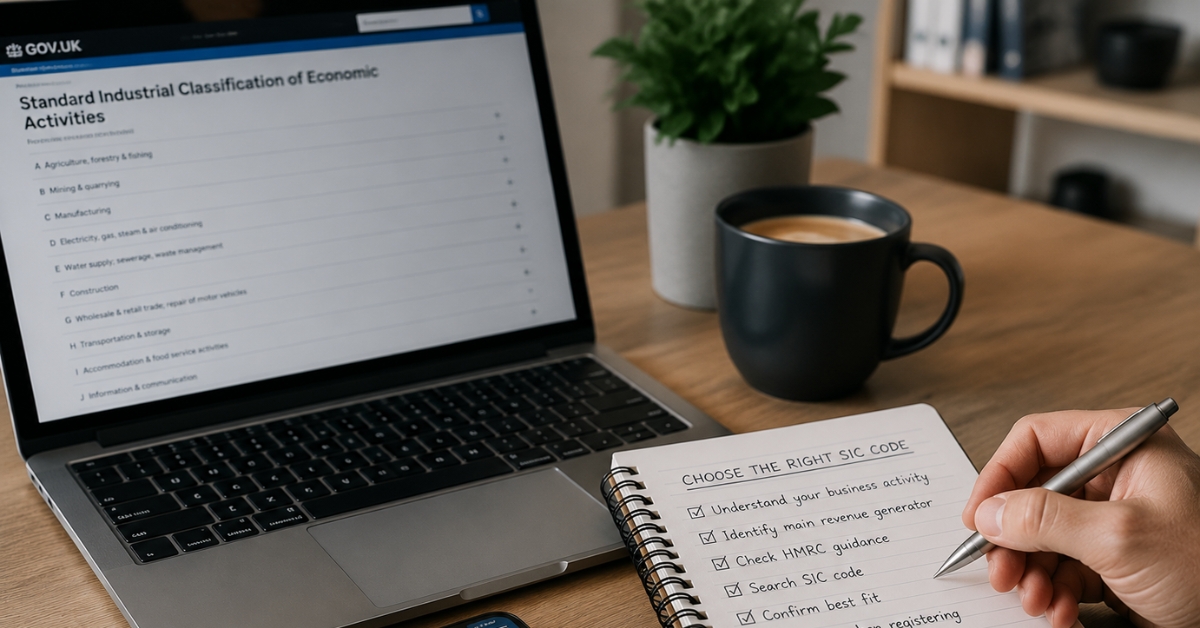
Finding the correct SIC code takes a little research, but several tools can help. Follow these steps to narrow down your choice:
- Identify your main business activity. Start with what your company primarily does. Think about how you’ll make most of your revenue. This helps focus on the core sector your code should reflect.
- Browse the official SIC code list. Companies House provides a condensed list of SIC codes (updated in 2025) that you must use when filing. You can search this list online or download it. Look under the broad category (like “Information Technology” or “Construction”) and find the description that most closely matches your activity. It’s okay if no code description is a perfect match – choose the closest fit.
- Use Companies House search tools. If you’re unsure between two codes, try the Companies House search service to see how similar businesses classify themselves. For example, if you plan to open a coffee shop that also sells records, you could search for “retail beverages” or “coffee shop” to see which code other coffee-shop companies use (in one example, a UK business used 47250: Retail sale of beverages in specialised stores for such a case). Seeing real-world examples can guide your choice.
- Consider multiple codes if needed. If your company truly has diverse activities, you can add up to four SIC codes. Just make sure the first code on the list is your main activity. For instance, a business that both develops software and offers consulting might list 62012 (software development) first and 62020 (IT consultancy) second.
- Read detailed descriptions. The SIC code list often has very specific wording. Read the descriptions carefully. Don’t just guess from the code number – the official description (e.g. “Management of real estate on a fee or contract basis”) helps ensure accuracy.
- Seek expert help if unsure. Accountants and company formation agents (like Interface Accountants and others) commonly assist clients with SIC code selection. If you’re uncertain, professional advisors can help interpret your activities and find the right code(s) for you.
By following these steps, you’ll converge on the best SIC code(s) for your business. Remember, the goal is to pick codes that accurately describe your operations – this makes future filings smoother and keeps your public record clear.
Common Business Examples and Their SIC Codes
To make this more concrete, here are some typical examples of UK businesses and the SIC codes they often use (from the official list):
- IT / Tech companies:
- Software development firms usually use 62012 (Business and domestic software development).
- IT consultants often use 62020 (Information technology consultancy activities).
- Companies providing data hosting or IT infrastructure might use 63110 (Data processing, hosting and related activities) or 63120 (Web portals) if they run a specialized web service.
- Retail businesses:
- Online shops or mail-order retailers commonly use 47910 (Retail sale via mail order or Internet).
- Physical stores might use a code under section G (e.g. 47110 for general retail) depending on what they sell.
- Food & hospitality:
- Restaurants and cafes typically use 56101 (Licensed restaurants).
- A pub or bar might use 56301 (Public houses), and a mobile food van might use 56210 (Event catering activities) – always read the description carefully.
- Professional services:
- Accountants and auditors use 69201 (Accounting and auditing activities), while legal consultants might use codes in section 69 (professional activities).
- Management consultants often use 70229 (Other business and management consultancy activities).
- Marketing or advertising agencies use codes like 73110 (Advertising agencies).
- Creative freelancers:
- A graphic designer or similar creative professional might use 74100 (Specialised design activities).
- A content creator or media producer might use codes in the 59100s (Film/TV) or 73100s (Marketing).
- Property / Construction:
- Letting or managing property (landlord activities) uses 68209 (Other letting and operating of own or leased real estate).
- Housebuilders or developers would use construction codes like 41202 (Construction of domestic buildings).
- Repair or maintenance firms use codes under section 43 (Construction).
- Miscellaneous:
- A freelance consultant might combine 70229 with 62020 if they offer both business and IT consultancy.
- A web-based startup might use one code for its primary platform and add others if it also engages in e-commerce or publishing.
Each business is unique, so use these examples only as a guide. Always refer back to the official SIC code descriptions to ensure a good fit. The goal is that someone reading the code on Companies House should clearly understand what your company does.
Updating Your SIC Code Over Time
Your SIC code isn’t set in stone you must keep it accurate as your business evolves. Companies House and HMRC expect the SIC code on record to match your company’s actual activities. Under recent law changes (the Economic Crime and Corporate Transparency Act), Companies House now actively checks that registered information remains correct.
If your business pivots or you realize you chose the wrong code, you can update it when you file your next Confirmation Statement (the annual return). The confirmation statement has an “Additional Information” section where you can change your SIC codes. It’s even possible to file this early if you need the change to take effect right away. Not updating your code (or using inappropriate codes like dormant for an active business) can trigger scrutiny or delays.
In practice, directors should review the SIC code at least once a year. Ask yourself: Is the code(s) still a good description of what we do? If not, update it promptly. Keeping your SIC code current is part of your ongoing compliance responsibility as a director. By doing so, you ensure that business partners and regulators always see an accurate picture of your company.
Conclusion
In summary, choosing the correct SIC code is an essential part of forming a UK company. It’s not just a bureaucratic checkbox it ensures legal compliance, clarifies your business to tax authorities and investors, and contributes to accurate industry data. To get it right, carefully consider your main activity, use the official Companies House list or search tools, and don’t hesitate to consult an accountant if you need clarity.
Once you’ve picked the code(s), remember that accuracy matters long-term. Review your SIC code whenever your business changes and update it via your confirmation statement. With the UK’s heightened focus on data accuracy, having the right SIC code positions your company for smoother compliance and better opportunities. In the future, as Companies House and HMRC continue to tighten standards, regularly verifying your SIC code will only become more important. By following the steps above and staying informed, you can ensure your company’s classification is correct – laying a strong foundation for growth and credibility in the UK marketplace.
Frequently Asked Questions
What is a SIC code and do I need one to form my company?
A SIC (Standard Industrial Classification) code is a five-digit number that identifies your company’s main business activity. Yes, every UK limited company must provide at least one SIC code when incorporating, as it’s required by Companies House.
How many SIC codes can a company have?
You can use up to four SIC codes if your business has multiple distinct activities. The first code should represent your primary activity, and additional codes can cover secondary lines of business.
What happens if I select the wrong SIC code?
If your SIC code is incorrect or not representative of your main activity, it can cause confusion for lenders or partners and may even delay filings. Fortunately, you can correct it on your next Confirmation Statement. However, persistently wrong information may be challenged or rejected by Companies House under the new regulations.
How can I update or change my SIC code after formation?
You update your SIC code by filing a Confirmation Statement with Companies House. In the confirmation statement’s additional information section, you can change your SIC code(s) to accurately reflect your current activities. You can also file this early if you need to make the change immediately.
Do I need a SIC code for a dormant or non-trading company?
Yes. Even dormant companies must select a SIC code when registering. The standard code for a dormant company is 99999. If your company is non-trading (active but not conducting business), the code 74990 is typically used. Never leave the field blank. These codes formally mark your status but remember to update them if your company starts trading or changes activity.