


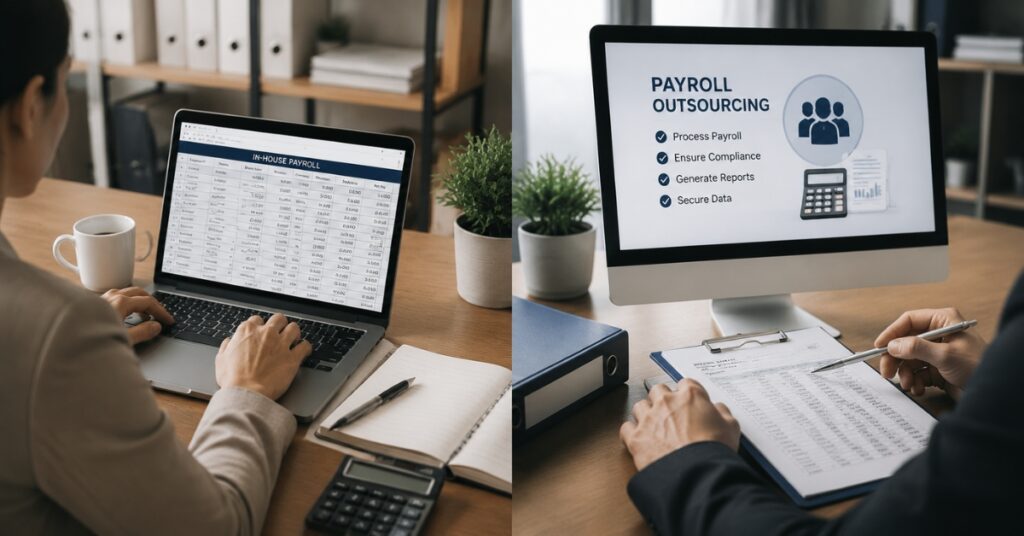
Payroll can look straightforward when a business has only a few employees. Calculate wages, make deductions, issue payslips and pay everyone on time. In practice, however, even a small payroll carries responsibilities that can quickly become time-consuming.
UK employers may need to manage PAYE, National Insurance, pension contributions, statutory payments, student loan deductions, starters, leavers and Real Time Information submissions. HMRC generally requires employers to report employee pay and deductions through a Full Payment Submission on or before payday, while payroll records normally need to be retained for at least three years after the relevant tax year.
This creates an important decision for small business owners: should payroll remain in-house, or should it be handed to an accountant or specialist payroll provider?
There is no universal answer. The right approach depends on the complexity of your workforce, the skills available within your business, the value of management time and how much payroll risk you are comfortable managing internally.
What Is the Difference Between In-House and Outsourced Payroll?
The main difference is who takes responsibility for carrying out the day-to-day payroll process.
How In-House Payroll Works
With an in-house arrangement, someone within the business manages payroll using suitable payroll software. In a very small company, this might be the owner. In a larger small business, it may be an administrator, bookkeeper, finance manager or dedicated payroll employee.
The internal team typically gathers employee information, processes wages, calculates deductions, issues payslips and submits the necessary payroll information to HMRC.
The main attraction is direct control. Changes can often be handled immediately, and payroll information stays closely connected to the people running the business.
How Payroll Outsourcing Works
With outsourced payroll, the business provides the required employee and pay information to an external accountant, payroll bureau or specialist provider. The provider then carries out some or all of the payroll administration.
The exact level of support varies. Some providers mainly process calculations, while others can prepare payslips, handle RTI submissions, support pension administration and provide payroll tax summaries.
HMRC confirms that employers can either operate PAYE themselves using payroll software or pay a payroll provider to handle the process. However, outsourcing the work does not remove the employer’s legal responsibility for ensuring PAYE obligations are completed correctly.
That distinction matters. Outsourcing can reduce the administrative burden, but business owners should still choose their provider carefully and ensure the information supplied to them is accurate and timely.
Why Payroll Is More Than a Monthly Calculation
The strongest argument for thinking carefully about payroll management is that payroll involves several connected responsibilities rather than a single calculation.
Every pay period can involve changes. An employee may receive overtime. Someone may join or leave. A worker may go on statutory leave. A tax code may change. Pension eligibility may need to be reviewed.
Employers operating PAYE generally need to calculate pay and deductions, produce payslips and report pay information to HMRC through RTI. Late or missing submissions can result in warnings or penalties, while inaccurate payroll information can also cause problems for employees.
Workplace pensions create another continuing responsibility. UK employers generally have automatic-enrolment duties from the point they employ eligible staff, including monitoring employee eligibility and managing ongoing pension obligations.
The question, therefore, is not simply whether someone in your business can calculate wages. It is whether your business can maintain an accurate and reliable payroll process every pay period, including when circumstances change.
When Running Payroll In-House Makes Sense
Keeping payroll internally can work extremely well for the right business.
You Have a Small and Straightforward Workforce
Consider a small consultancy with four salaried employees. Everyone receives the same salary each month, there is little overtime, and staff turnover is low.
In this situation, payroll may require relatively few changes from one month to the next. With suitable software and someone who understands the process, managing payroll internally may be practical.
You Want Immediate Control Over Payroll Changes
An internal payroll administrator can sometimes respond more quickly to last-minute information.
For example, a restaurant manager may discover shortly before payroll closes that several employees have additional overtime hours. An in-house team with access to the relevant systems may be able to make the adjustment without sending instructions to an external provider.
This level of control can be valuable in businesses where pay frequently changes.
You Already Have Suitable Payroll Expertise
The economics of in-house payroll change significantly when the necessary expertise already exists.
A business with an experienced finance manager may not need to buy additional external support for a relatively simple payroll. The employee is already familiar with the workforce, internal approval procedures and company systems.
The important point is that payroll should be assigned to someone with enough knowledge and protected time to manage it properly. Giving payroll to an already overloaded employee simply because they are available can create more risk than it saves in professional fees.
The Hidden Costs of Keeping Payroll In-House
The most obvious cost of internal payroll is software and staff time. The less obvious costs often matter more.
A business owner may spend several hours each month gathering information, checking calculations and resolving employee queries. That time has an opportunity cost, particularly when the owner could otherwise be working with customers, managing staff or developing the business.
There is also a continuity risk. When only one person understands the payroll process, what happens if they are unexpectedly absent immediately before payday?
Internal payroll can also become harder as the workforce becomes more varied. A business that begins with five fixed-salary employees may later introduce bonuses, hourly workers, statutory leave, pension changes or multiple pay frequencies. The payroll process that once took an hour may gradually become a significant administrative responsibility.
For this reason, businesses should consider the full internal cost rather than comparing only the price of payroll software with an accountant’s monthly fee.
When Payroll Outsourcing Is Usually the Better Option
Outsourcing becomes increasingly attractive when payroll starts consuming management attention or requiring knowledge that the business does not naturally have.
Your Payroll Has Become More Complicated
A growing care business, for example, might employ salaried managers alongside hourly staff working different shifts. Employees may receive overtime, holiday pay and statutory payments, while starters and leavers are common.
The payroll itself may not be impossible to manage internally, but the number of moving parts increases the chance that something will be overlooked.
A specialist provider works with payroll processes regularly, which can make outsourcing particularly valuable where frequent employee changes and variable pay are involved.
Your Business Does Not Have a Dedicated Finance Team
For many small companies, the person processing payroll is also responsible for bookkeeping, invoicing, customer administration and numerous other tasks.
Outsourcing allows payroll to become a managed process rather than another deadline competing for internal attention.
Interface Accountants, for example, describes a payroll process that includes requesting payroll information, preparing payslips and payroll tax summaries, and submitting RTI returns to HMRC.
You Need Better Business Continuity
Employees still expect to be paid correctly when the business owner is on holiday or an administrator is off sick.
An established payroll provider should have processes that are less dependent on a single person. For a small business with a lean internal team, that continuity can be one of the strongest reasons to outsource.
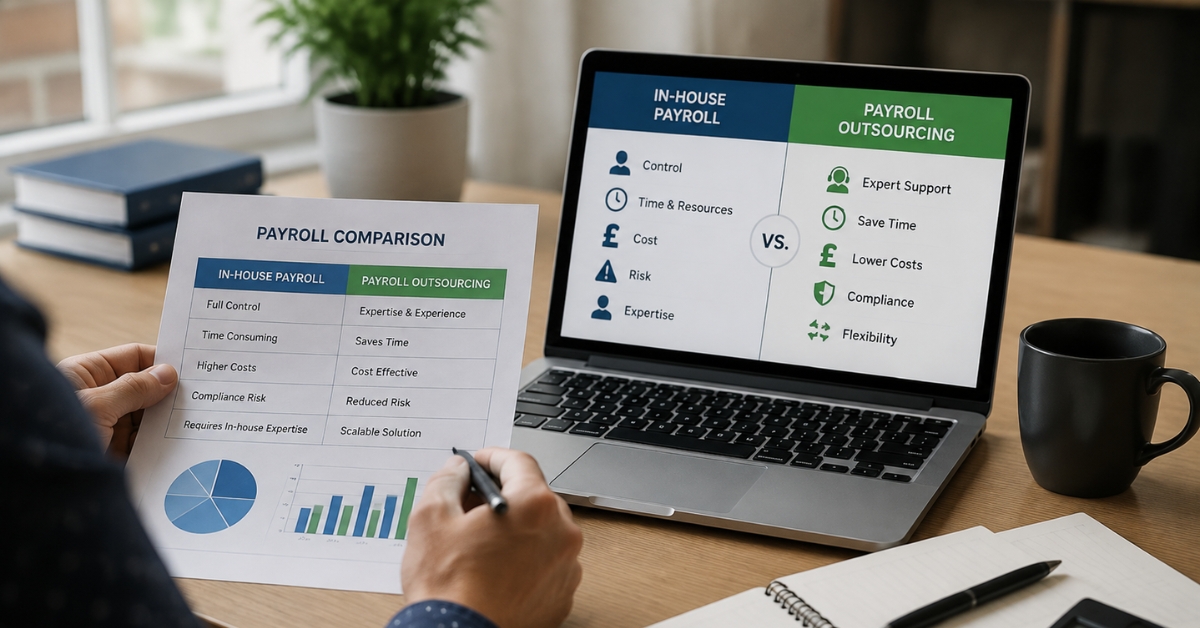
Comparing the Real Cost of Outsourced and In-House Payroll
A useful cost comparison should look beyond the visible monthly price.
When assessing each option, consider:
- Staff time: How many hours are actually spent gathering information, processing payroll, checking results and answering questions?
- Software and training: What does the business pay for payroll systems, updates and employee knowledge?
- Error correction: How much management time would be lost if an employee were paid incorrectly or an HMRC submission needed correcting?
- Continuity: Who processes payroll when the usual person is unavailable?
- Growth: Will the current process remain manageable if the workforce doubles?
- Professional fees: What is included in the outsourcing price, and which services cost extra?
For a three-person company with stable salaries, running payroll internally may remain economical. For a 25-person business with variable hours, regular starters and pension administration, a relatively small monthly outsourcing fee may represent good value once internal time and risk are taken into account.
The correct comparison is therefore not simply software cost versus outsourcing fee. It is total internal workload versus the total cost and value of external support.
What Are the Main Drawbacks of Outsourcing Payroll?
Outsourcing solves many problems, but it also introduces new considerations.
The first is communication. Your provider can only process payroll accurately when they receive accurate information. If overtime figures, new starter details or salary changes arrive late, outsourcing cannot automatically fix the underlying problem.
There may also be cut-off dates for payroll changes. A business accustomed to making adjustments at the last minute may need more disciplined internal procedures after outsourcing.
Data handling also deserves attention because payroll involves sensitive personal and financial information. ICO guidance makes clear that organisations using third-party providers to process employee information remain responsible for choosing appropriate processors and ensuring suitable contractual and data-protection arrangements are in place.
Finally, business owners should avoid assuming that outsourcing removes all responsibility. HMRC explicitly states that employers remain legally responsible for PAYE tasks even when a payroll provider performs them.
A good outsourcing arrangement should therefore involve clear responsibilities on both sides rather than complete disengagement by the employer.
Three Real-World Scenarios: Which Option Works Better?
A Five-Person Professional Services Company
All employees receive fixed monthly salaries. Changes are rare, and the company has an experienced bookkeeper.
Likely best option: In-house payroll may be perfectly suitable.
The process is predictable, the necessary knowledge exists internally and the administrative workload is limited.
A Growing Retail Business With 20 Employees
The company employs full-time and part-time workers. Hours change every month, staff turnover is moderate and the owner currently checks payroll personally.
Likely best option: Outsourcing is likely to offer greater value.
Variable pay and frequent workforce changes increase administrative pressure. The owner’s time may also be more valuable elsewhere in the business.
A Fast-Growing Company With an Internal Finance Manager
The business expects to increase its workforce substantially but already has an experienced finance team.
Likely best option: Either a strong in-house system or a hybrid model.
The finance team may keep responsibility for employee data and payroll approvals while a specialist provider handles processing and submissions.
These examples show why employee numbers alone should not determine the decision. Ten employees with complicated pay arrangements can create more payroll work than 30 employees receiving identical fixed salaries.
A Practical Checklist for Choosing the Right Payroll Model
Before deciding, ask the following questions:
- Does someone internally genuinely understand UK payroll responsibilities?
- How often do employee pay and circumstances change?
- How much management time is payroll currently consuming?
- Is the process dependent on one employee?
- Could the business manage payroll confidently during sickness or holidays?
- Are payroll errors or missed deadlines becoming a concern?
- Is the workforce expected to grow or become more complex?
- Would external support free key employees to focus on more valuable work?
If most of these questions expose weaknesses in the current process, outsourcing deserves serious consideration.
Could a Hybrid Payroll Model Be the Best Choice?
The decision does not have to be completely in-house or completely outsourced.
Many small businesses benefit from dividing responsibilities.
The business can retain control over employee records, hours, salary decisions and final approvals while an external accountant handles calculations, payslips and HMRC submissions.
This arrangement can offer a useful balance. Business owners maintain visibility over employee pay without needing to become payroll specialists themselves.
A hybrid structure can also help businesses that are growing. Internal processes remain close to management, while specialist technical work is supported externally.
Payroll Outsourcing vs In-House Payroll: Which Is Better?
For very small businesses with stable employees, straightforward salaries and reliable internal expertise, in-house payroll can remain efficient and cost-effective.
For businesses with variable pay, regular workforce changes, limited internal finance resources or growing compliance demands, outsourcing will often be the more practical choice.
The key issue is not whether payroll can technically be done in-house. Most businesses can purchase software and learn the basic process.
The better question is whether running payroll internally is the best use of the company’s people, time and management attention.
Outsourcing is usually strongest when it removes a genuine operational burden. In-house payroll is strongest when the business already has the right skills, systems and capacity.
Conclusion
Payroll is one of those business functions that often becomes more demanding gradually. A process that feels simple with three employees can become significantly harder once a company introduces variable hours, workplace pensions, statutory payments and regular staff changes.
Small businesses should therefore review their payroll model as the company develops rather than assuming that the system used in the early stages will always remain suitable.
Keeping payroll in-house provides control and can work efficiently where the workforce is stable and capable internal staff are available. Outsourcing can provide specialist support, stronger continuity and more management time, particularly as payroll becomes more complex.
For businesses considering professional support, Interface Accountants provides payroll services including payroll processing, payslips, payroll tax summaries and RTI submissions to HMRC.
The strongest long-term payroll model is ultimately the one that keeps employees paid accurately and on time while allowing the business to grow without payroll administration becoming an unnecessary distraction.
Frequently Asked Questions
Is it cheaper to outsource payroll or run it in-house?
It depends on payroll complexity. In-house payroll may cost less for a very small, simple workforce, while outsourcing can be better value when staff time, software, training and compliance work are included.
Does outsourcing payroll remove the employer’s legal responsibility?
No. The employer remains legally responsible for completing PAYE obligations correctly, even when a payroll provider carries out the work.
Can a small business run its own payroll?
Yes. UK businesses can operate payroll themselves using suitable payroll software, provided they meet their reporting, payment and record-keeping obligations.
When should a business consider outsourcing payroll?
Outsourcing is worth considering when payroll becomes time-consuming, complicated, dependent on one employee or difficult to manage alongside business growth.
Can an accountant handle payroll and workplace pensions?
Many accountancy and payroll providers support payroll processing alongside aspects of workplace pension administration. The exact service varies, so businesses should confirm what is included before appointing a provider.