


Keeping a limited company dormant can be a sensible decision. You may be protecting a business name, holding a company for a future project, pausing operations or simply keeping an existing corporate structure in place until circumstances change.
However, dormant does not mean free from compliance.
One of the most common mistakes directors make is assuming that a company with no sales, employees or business activity has nothing to file. In reality, virtually all dormant limited companies must continue meeting their statutory obligations with Companies House. This includes filing annual accounts and a confirmation statement, even when the company has not traded during the year.
Understanding exactly what needs to be submitted can help directors avoid penalties, rejected filings and the risk of the company eventually being removed from the register.
What Does a Dormant Company Mean for Companies House?
For Companies House purposes, a company is generally considered dormant when it has had no significant accounting transactions during its financial year.
A significant accounting transaction is broadly a transaction that would normally need to be entered into the company’s accounting records. Certain limited transactions can be ignored when determining dormancy, including Companies House filing fees, penalties for late filing of accounts and payments for shares made when the company was incorporated.
This distinction matters because simply having no sales does not automatically make a company dormant.
For example, imagine a company that has stopped serving customers but continues paying subscriptions, professional fees or other business expenses. Those transactions may need to appear in its accounting records, meaning the company may no longer qualify to file dormant accounts.
Directors should therefore check the company’s actual financial activity rather than assuming that “not trading” and “dormant” always mean exactly the same thing.
What Must a Dormant Company File with Companies House?
A dormant limited company normally has two continuing annual filing responsibilities.
- Annual accounts: Accounts must still be delivered to Companies House for each financial year.
- Confirmation statement: The company must review and confirm its registered information at least once every 12 months, even if nothing has changed.
Companies House requires these filings whether a company is active or dormant. The confirmation statement also now includes additional compliance requirements, including confirmation that the company’s intended future activities will be lawful.
These are separate obligations with separate deadlines. Filing dormant accounts does not replace the confirmation statement, and submitting a confirmation statement does not satisfy the annual accounts requirement.
What Information Is Included in Dormant Company Accounts?
Dormant company accounts submitted to Companies House are generally simpler than accounts for an active trading business.
Qualifying dormant accounts do not need to include a profit and loss account or directors’ report when filed with Companies House. However, the accounts normally still need to contain a balance sheet, comparative figures from the previous year where applicable and certain required notes.
The balance sheet must also include the required statements confirming the company’s dormant status and must carry the relevant director’s printed name and approval.
This may sound straightforward, but the exact accounting treatment can depend on the company’s history.
A Company That Has Never Traded
A newly incorporated company that has never traded and has only had permitted incorporation-related transactions will usually have relatively simple dormant accounts.
Companies House provides an online filing route for eligible dormant companies that have never traded. The online process includes built-in checks designed to reduce common filing errors.
A Company That Traded in Previous Years
A company can stop trading and later become dormant, but its accounts may require more attention.
Assets, liabilities, loans, retained earnings or other balances from previous trading periods do not automatically disappear simply because the company has stopped operating. The dormant accounts may therefore still need to reflect the company’s financial position correctly.
The simplified AA02 paper form, for example, is not suitable for every dormant company and is not intended for companies that became dormant after previously trading.
This is one situation where professional preparation of the accounts can be particularly valuable.
When Are Dormant Company Accounts Due?
Dormant companies generally have the same Companies House accounts filing deadlines as other companies.
For most private limited companies filing subsequent annual accounts, the deadline is normally nine months after the end of the accounting reference period. Special rules apply to first accounts, particularly where the first accounting period is longer than 12 months.
A practical example helps.
Suppose a private limited company’s financial year ends on 31 December. Its annual accounts would normally need to reach Companies House by 30 September of the following year.
The important point is that dormancy does not pause the filing clock. A company that has made no sales throughout the year can still receive an automatic late filing penalty if its accounts arrive after the deadline.
Directors should therefore treat dormant company deadlines with the same seriousness as the accounts deadlines of an active business.
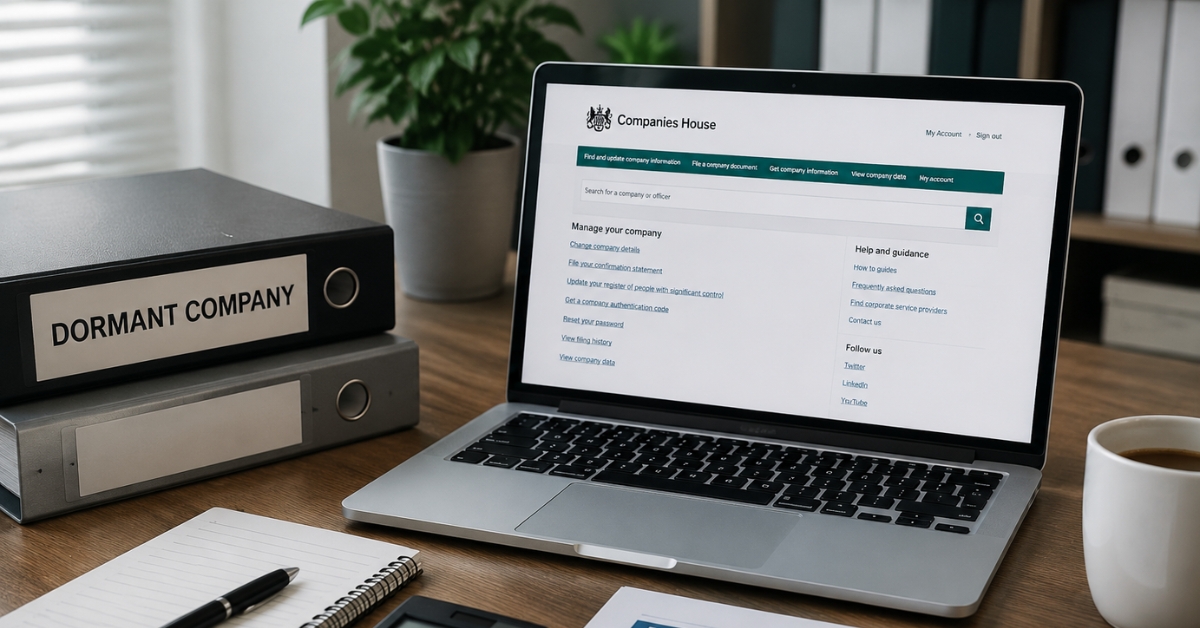
Do Dormant Companies Need to File a Confirmation Statement?
Yes.
Every company, including dormant and non-trading companies, must normally file at least one confirmation statement during each 12-month review period. This is required even where none of the company’s registered information has changed.
The confirmation statement is used to confirm that Companies House holds accurate information about matters such as the company’s registered details, shareholders and other relevant company information.
Companies must also provide a registered email address if one has not already been supplied and confirm that the company’s intended future activities will be lawful.
Under the current identity-verification requirements, directors need to complete the relevant Companies House verification process and provide their personal codes when required as part of the company’s confirmation statement process. A confirmation statement cannot be completed where the applicable director identity-verification requirements have not been satisfied.
This makes it sensible to deal with identity verification before the confirmation statement deadline rather than discovering a problem on the final filing day.
Is Dormancy the Same for HMRC and Companies House?
Not necessarily. Companies House and HMRC apply dormancy in different contexts. A company can therefore have separate obligations with each organisation.
For Corporation Tax purposes, HMRC generally treats a company as dormant when it is not carrying on business activity and has no other relevant income. Activities such as trading and receiving certain income can affect that status.
When a company becomes dormant for Corporation Tax, HMRC should normally be informed. Once HMRC has accepted the company’s dormant status, the company will generally not need to submit further Company Tax Returns unless HMRC asks for one or the company begins trading again.
However, receiving a notice to deliver a Company Tax Return can still create a filing obligation for the period concerned.
The key practical lesson is simple: telling HMRC that a company is dormant does not remove the requirement to file the appropriate annual accounts and confirmation statement with Companies House.
Transactions That Can Accidentally Affect Dormant Status
Maintaining dormancy requires more than simply deciding not to trade.
Directors should monitor the company carefully and consider whether any transaction needs to be entered into its accounting records. Potential issues can arise where a dormant company starts making payments, earning income or carrying out commercial activity.
Before filing dormant accounts, review whether the company has:
- Carried Out Any Sales Or Supplied Services
- Received Business Or Investment Income
- Paid Expenses That Are Not Specifically Disregarded Under The Dormant-Company Rules
- Entered Into New Financial Transactions
- Restarted Commercial Activities During The Accounting Period
Because Companies House defines a significant accounting transaction as one that should be entered in the company’s accounting records, even a relatively small transaction can matter when deciding whether dormant accounts are appropriate.
The value of the transaction is not necessarily the main issue. Its accounting nature is what matters.
What Happens If Dormant Accounts Are Filed Late?
Dormant companies are subject to the same automatic late filing penalty system for annual accounts as other companies.
For a private company, current penalties start at £150 where accounts are no more than one month late and can rise to £1,500 where they are more than six months overdue. The penalty can also be doubled where accounts are filed late in two successive financial years.
Continued failure to meet statutory filing obligations can have more serious consequences. Companies House can take steps towards striking a company off the register, while failure to deliver required documents can also create legal consequences for directors.
For a dormant company being retained for future use, losing it because of missed administrative deadlines can create unnecessary cost and disruption.
Common Dormant Company Filing Mistakes
Many compliance problems arise from misunderstandings rather than complex accounting.
One common mistake is assuming that informing HMRC of dormancy automatically updates Companies House. The two organisations have separate responsibilities and filing requirements.
Another is filing dormant accounts without checking transactions made during the year. A company that has incurred reportable financial activity may need a different type of accounts.
Directors also sometimes overlook the confirmation statement because no company details have changed. However, the statement is still required even when all information remains exactly the same.
Finally, leaving filings until the deadline creates unnecessary risk. Accounts submitted incorrectly can be rejected, and Companies House does not automatically provide extra filing time simply because an attempted submission was unsuccessful.
Good dormant-company management therefore involves reviewing activity throughout the year rather than treating compliance as a once-a-year formality.
When Should You Get Professional Help with Dormant Accounts?
Straightforward companies that have never traded may be relatively easy to manage. However, professional accounting support can be useful where the company has a more complicated history.
For example, advice may be worthwhile when a company:
- Previously Traded Before Becoming Dormant
- Still Has Assets, Liabilities, Loans Or Historical Balances
- Has Made Transactions That Could Affect Its Dormant Status
- Has Received A Company Tax Return Notice From Hmrc
- Is Part Of A Group Or Has A More Complex Ownership Structure
An accountant can review whether the company genuinely qualifies as dormant, prepare the appropriate accounts and help keep Companies House and HMRC obligations aligned.
For businesses that want support with statutory accounts and ongoing company compliance, professional services such as those provided by Interface Accountants can help reduce the risk of missed requirements and incorrect filings.
The Future of Dormant Company Accounts Filing
Dormant-company compliance is becoming increasingly digital.
Companies House has confirmed that accounts filed on or after 1 April 2028 will need to be submitted using commercial software in iXBRL format. The existing web and paper routes for filing company accounts are expected to close from that date.
This means even very small and dormant companies will need to consider how they manage digital accounts filing in the coming years.
The underlying responsibility, however, remains unchanged: keeping a company dormant does not put its statutory obligations to sleep.
Conclusion
A dormant company may have little or no day-to-day business activity, but it remains a registered legal entity with continuing compliance responsibilities.
In most cases, directors must continue filing annual accounts and a confirmation statement with Companies House. They must also separately consider the company’s Corporation Tax position with HMRC and check that no transactions during the year have affected its dormant status.
The safest approach is to review the company’s activity before each filing period, keep accurate records and monitor every statutory deadline. As Companies House moves towards more digital and identity-based compliance processes, maintaining accurate company information will become even more important.
Dormancy can keep a company available for future opportunities without the administrative demands of active trading, but only when its annual filing responsibilities are managed correctly.
Frequently Asked Questions
Does a dormant company have to file annual accounts?
Yes. Limited companies generally have to file annual accounts with Companies House even when they are dormant.
Does a dormant company need a confirmation statement?
Yes. A confirmation statement must normally be filed at least once every 12 months, even if the company’s details have not changed.
Do dormant companies pay Corporation Tax?
A company that is genuinely dormant for Corporation Tax will generally have no Corporation Tax to pay, but HMRC should be informed of its status and any outstanding filing notices must be dealt with.
Can a company with expenses still file dormant accounts?
Not always. Transactions that must be entered into the company’s accounting records can affect its dormant status, except for certain specifically excluded transactions.
What happens when a dormant company starts trading again?
The company will no longer qualify as dormant for the relevant period once it resumes qualifying business activity. HMRC must be informed when trading restarts, and the next Companies House accounts should reflect the company’s active status.