



Cryptocurrency staking locking up coins to help secure a blockchain and earn rewards has become a popular way for crypto holders to generate passive income. However, this new form of income brings complex tax questions for UK investors. As of 2026 HMRC treats most staking rewards as taxable income at the time you receive them. It’s crucial for anyone earning through staking to understand how this income is reported and taxed. In this guide, we’ll explain HMRC’s rules on staking income, outline the practical steps for reporting it, and highlight how this tax fits into overall crypto taxation. By the end, you’ll know when and how much tax you may owe and how to stay compliant with HMRC’s requirements.
What Counts as Staking Income?
Staking involves locking your tokens (often on Proof-of-Stake blockchains like Ethereum, Cardano or Solana) to help validate transactions. In return, the network pays out new coins or tokens as rewards. In HMRC’s eyes, these staking rewards are typically income. If you are simply an individual stakeholder and not running a formal trading business, the new tokens you receive are classified as miscellaneous income. HMRC’s crypto guidance confirms that “where a proof of stake activity does not amount to a trade, income rewards received in exchange for staking tokens will be taxable as miscellaneous income”. In plain terms, this means:
- The GBP value of each batch of staking rewards (at the moment you receive them) is treated as taxable income.
- This income is taxed at your normal Income Tax rates (20%, 40% or 45%), just like salary or other earnings.
- You can subtract any allowable expenses (such as costs incurred specifically in earning those rewards) to reduce taxable income.
- If you later sell or dispose of the coins you earned, that sale is a separate Capital Gains Tax (CGT) event (see below).
In practice, HMRC lumps staking rewards with other similar crypto income (like mining and airdrops). The official guidance puts staking under the category “other taxable income” if you aren’t a crypto trader by profession. Importantly, individual investors get a £1,000 annual allowance for all trading and miscellaneous income combined. If your total income from staking (plus any other small earnings) is under £1,000 in a tax year, you pay no tax on it. If you exceed that threshold you must inform HMRC (for £1,000–£2,500 total) or complete a Self Assessment tax return (over £2,500).
Trade vs. Hobby: When Staking Could Be a Business
Not everyone’s staking activity is treated the same. If you’re running a sizable staking operation – frequently earning large amounts, marketing yourself as providing a staking service, or pursuing it with the intention of profit HMRC might consider it a trade. In that case, the income is treated like business profits. For a crypto “financial trader”, staking rewards could be classified as trading income rather than miscellaneous income. HMRC looks at factors such as the scale of activity, how organized it is, your intention and expertise, and the risk involved. As Blockpit explains, “if you are a ‘financial trader’ in cryptoassets, these rewards may be treated as trading income… based on factors like frequency, intention, expertise and commerciality”. In other words, casual personal staking is taxed simply as income, but a professional operation must consider business-like taxation rules (e.g. allowable business expenses) and may face National Insurance obligations as well.
Key takeaways on income tax:
- Non-trader: Staking rewards = miscellaneous income at receipt value. Use the £1,000 allowance.
- Trader: Staking rewards = trading profits (report on Self Assessment, deduct expenses).
- Example: If you stake tokens worth £50 and receive £5 worth of crypto reward, you report £5 as income for that day. Over the year, tally all rewards in GBP. If the total exceeds £1,000, you declare it on your tax return.
Capital Gains Tax on Staked Assets
Staking doesn’t just affect income tax it can trigger Capital Gains Tax (CGT) too. Here’s how it works:
- Tokens You Receive: When you eventually dispose of (sell or swap) the tokens you got from staking, HMRC treats that as a standard CGT event. Your acquisition cost for CGT purposes is the GBP value of those tokens when you received them. Any subsequent sale price above that cost is a taxable gain. For example, if you got a staking reward worth £100 and later sold it for £150, you have a £50 capital gain (subject to CGT after your annual CGT allowance).
- Tokens You Stake (If Ownership Changes): In some staking setups, you might give up “beneficial ownership” of your tokens (for example, sending them to a third-party staking pool). HMRC treats that as a disposal for CGT purposes. In practice, this means two extra CGT calculations: one when you lock up the tokens and one when you unlock/withdraw them. If the tokens’ value changed while they were staked, you could have a gain or loss. For most retail stakers (who merely delegate tokens via a non-custodial wallet), beneficial ownership isn’t lost, and no CGT event occurs until sale. But if, say, a platform takes control of your tokens as part of a staking contract, HMRC’s rules consider it as if you temporarily sold them.
- Record and report: Always record the GBP value of tokens at each staking event (both when received and if locked/unlocked). Then use HMRC’s share pooling rules to calculate gains/losses on disposal. Remember that individuals have a CGT annual exemption (around £6,000 for 2023/24, falling to £3,000 for 2025/26 onward). Any gains above that are taxable at 10% (basic rate) or 20% (higher rate) (no special crypto rate).
In short, staking income has a double tax aspect: taxed as income when received, and taxed again on any later gain upon selling those tokens. The only “CGT relief” currently proposed by HMRC would be to ignore artificial disposals for some DeFi and staking arrangements, but this is still under consultation. Until any new rules arrive, plan on handling both taxes.
Reporting Obligations and Record-Keeping
Staying compliant with HMRC means meticulous records. HMRC explicitly requires you to keep details of all staking and related crypto activity. At minimum, record the following for each staking income event:
- Token details: Name of cryptocurrency, number of coins received.
- Dates: When you received the staking reward (and when you started/stopped staking, if applicable).
- GBP value: The market value in sterling at the time you received each reward (or locked/unlocked tokens).
- Disposal info: If you later dispose of any staked tokens or rewards, record the sale date, price, and platform used.
- Source wallets/exchanges: Keep statements or screenshots from exchanges/wallets showing the transactions.
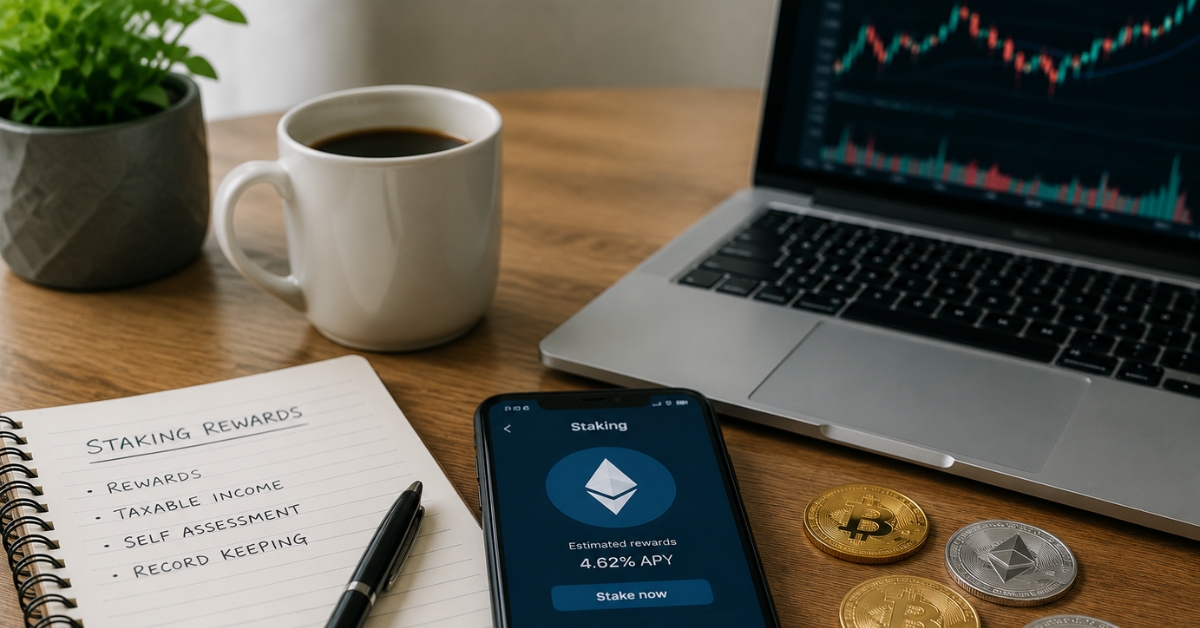
HMRC may ask for these records in a compliance check, so organized logs are crucial. Many crypto tax software tools can help aggregate this data.
You also need to understand when and how to report. The basic rule is: if your total miscellaneous crypto income (from staking, mining, etc.) is £1,000 or less in the tax year, you don’t need to pay tax or notify HMRC separately. If it exceeds £1,000, you must tell HMRC – for £1,000–£2,500 you can usually just call them, but if it’s over £2,500 you should register for Self Assessment and file a tax return. Within the Self Assessment return, include staking rewards under “other income.” Of course, all capital gains from selling staked assets must also be reported in the capital gains section of the return if they exceed the annual CGT allowance.
Bullet list: Key record-keeping and reporting steps
- Keep a running log of all staking rewards in GBP and coins, updated as transactions occur.
- Take note of dates and values for any tokens staked or unstaked (possible CGT events).
- Use crypto accounting software or spreadsheets to track your income totals against the £1,000 allowance and CGT allowance.
- If you breach the threshold, register for Self Assessment and enter crypto staking earnings as miscellaneous income.
- When selling any staking-acquired coins, calculate CGT by using the receipt-date value as the acquisition cost.
Being proactive is important. Even if you’ve never reported crypto earnings before, it’s best to start now to avoid HMRC penalties later.
Conclusion
Cryptocurrency staking can be a lucrative venture, but UK tax law treats those rewards much like any other income. In practice, staking rewards are taxed as income when received (unless you qualify as a full-time trader), and you may also face capital gains tax when disposing of those coins. Keeping good records and understanding the allowances (currently a £1,000 miscellaneous income allowance each year) are essential steps to compliance.
Ultimately, the taxes on staking depend on your personal circumstances: how active your staking is, whether it resembles a business trade, and how long you hold the coins. Given HMRC’s growing focus on crypto (including ongoing consultations to potentially simplify DeFi and staking taxation), it pays to stay informed. In any case, accurate reporting protects you from surprise tax bills and penalties. By tracking every reward in GBP, declaring income above the thresholds, and accounting for any gains when you sell, you can enjoy staking while keeping your tax affairs in good shape.
Looking ahead, HMRC has indicated it may adjust the rules to better match the economics of DeFi and staking for example, possibly treating certain staking transactions on a “no gain/no loss” basis. For now, though the safest approach for investors is to treat staking rewards as taxable income and plan for CGT on their sale. With correct reporting and perhaps professional advice, stakers can maximise their returns and minimise tax risks under UK law.
Frequently Asked Questions
Is cryptocurrency staking income taxable in the UK?
Yes. Any crypto tokens you receive from staking are generally considered taxable income at the time you get them. HMRC classifies these rewards as miscellaneous income (unless you’re staking as part of a trading business). You must include the GBP value of each reward on your tax return if your total crypto income exceeds the £1,000 allowance.
Do I need to register for Self Assessment if I stake crypto?
It depends on how much you earn. You can earn up to £1,000 in miscellaneous income tax-free (this covers all crypto income including staking). If your staking rewards push your total above £1,000, you should notify HMRC. If the total exceeds £2,500, you must register for Self Assessment and file a tax return. Otherwise, no separate tax event is triggered by small amounts under £1,000.
How is capital gains tax applied to staking?
When you sell or exchange the crypto you earned from staking, CGT applies to any gains. Your acquisition cost is the value in GBP when you received the reward. For example, if you got 1 ETH worth £2,000 as a reward and later sold that ETH for £2,500, you have a £500 capital gain (minus your annual CGT exemption). Also, if you transferred tokens to stake in a way that gave up ownership, HMRC treats that as if you sold them at that time (and again when you get them back).
What records do I need to keep for staking transactions?
HMRC expects detailed records. You should track each staking reward’s date, crypto type, amount, and its value in sterling at receipt. If you later sell those tokens, record the sale date and price as well. Keeping exchange or wallet statements is also advised. These records prove your calculations for income and CGT and will be needed if HMRC queries your return.
Can I deduct any expenses against my staking income?
Only limited costs can reduce your taxable income. Generally, you can deduct expenses directly related to earning the staking rewards (for example, any network fees paid to claim rewards). But routine holding costs (like electricity for home staking) usually don’t qualify. In practice, most individuals report the full value of staking rewards as income (minus any small claimable costs). If you have questions about specific deductions, consider consulting a tax advisor.