


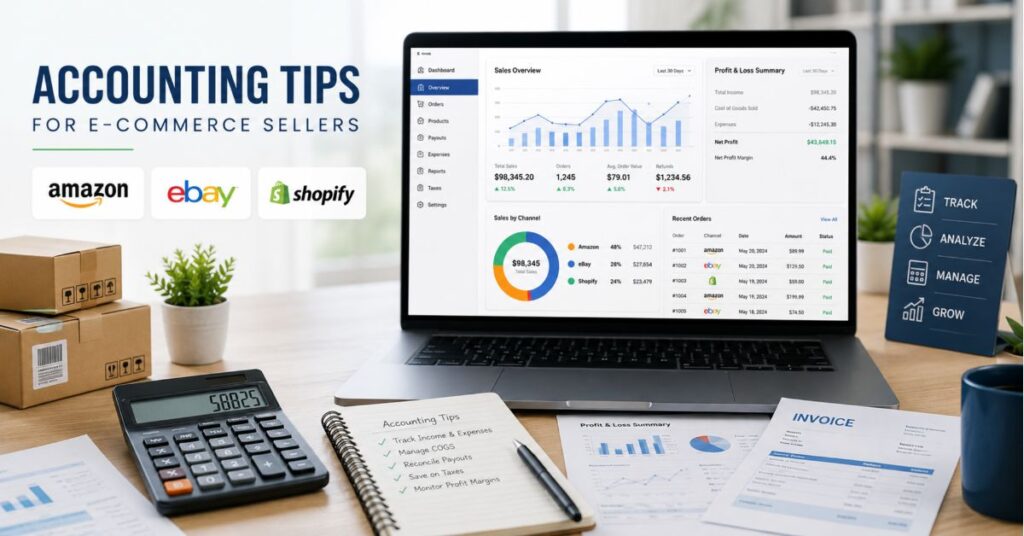
Most people who start selling online don’t fail because their product is bad. They get tripped up by the money side and usually not in the way they expect. The orders come in, the bank balance goes up and it all feels like it’s working, right up until a VAT bill or a tax return lands and the numbers don’t say what they thought they said.
Selling through Amazon, eBay or Shopify adds a layer that ordinary small businesses don’t deal with. The platform sits between you and your customer, takes its cut before you ever see the cash, handles some of the tax in certain situations, and hands you a settlement report that reads like it was written to be ignored. If you treat that platform like a simple shop till, the gaps add up fast.
Here’s what actually trips sellers up, and how to stay on top of it.
The money in your bank is not your sales
This is the mistake I see more than any other, and it’s an expensive one.
Say you sell £10,000 of stock through Amazon in a month. Amazon takes referral fees, FBA fees, advertising costs and a few other charges, then pays the remainder into your account. You might see £6,800 land. The natural instinct is to think “I made £6,800.” For tax and VAT purposes, you didn’t. Your turnover is the full £10,000. The £3,200 difference is business expenses, and you account for the sale and the fees separately.
Why it matters: VAT registration is based on turnover, not on what hits your bank. A seller who watches their payouts and thinks they’re nowhere near the threshold can quietly sail past it because the gross sales figure is much higher than the net deposits. By the time anyone notices, there’s backdated VAT to pay out of money that’s already gone.
So the first habit to build is reading the settlement or payout reports properly, not just the bank feed. Amazon, eBay and Shopify all give you a breakdown. That breakdown is your real bookkeeping source, and the bank deposit is just the leftover.
Get ahead of VAT before it gets ahead of you
VAT is where e-commerce accounting goes from fiddly to genuinely confusing, mostly because the platform sometimes handles it and sometimes doesn’t.
The basics first. If your taxable turnover goes over £90,000 in any rolling 12-month period, you have to register for VAT with HMRC. “Rolling” is the word people miss. It isn’t your tax year or calendar year, it’s any 12 months, so you need to keep a running total rather than checking once a year.
Where it gets layered is the marketplace rules. In some cases the platform itself becomes the “deemed supplier” and collects the VAT on a sale for you, particularly where goods are coming in from overseas or sold by an overseas business through the marketplace. If you’re a UK-based seller holding UK stock, you’re generally still responsible for your own VAT, but the moment you start importing, holding stock abroad, or selling into the EU, the picture changes.
A few situations that catch sellers out:
- Selling to EU customers after Brexit, where you may need to deal with import VAT, the IOSS scheme, or registration in another country depending on volumes.
- Using Amazon’s European fulfilment, which can mean your stock is physically stored in another country and triggers a VAT obligation there.
- Assuming “Amazon handles the VAT” across the board, when in reality it only applies to specific types of sale.
None of this means you need to panic at £40,000 of sales. It means you should know roughly where you’ll cross the line and what your situation will require before you get there, not after.
Don’t lose money on the VAT sitting inside your platform fees
This one is quieter and costs sellers real money.
The fees Amazon, eBay and Shopify charge you can carry VAT, and if you’re VAT registered you can often reclaim it. The catch is that how these fees are billed has shifted in recent years, and the treatment depends on whether the platform charges you UK VAT directly or whether the reverse charge applies because the supplier is based abroad.
Practically, the thing to do is look at your actual fee invoices rather than assume. Check whether UK VAT is being added. If it is and you’re registered, that’s input VAT you can claim back. If your fees fall under the reverse charge, your bookkeeper needs to record them correctly on your VAT return so you neither overpay nor get it wrong. Rules in this area have changed more than once, so it’s worth checking your current invoices rather than relying on what was true two years ago.
Know your margin on every product, not just overall
Plenty of sellers know their total profit at the end of the year. Far fewer know which products are actually making money, and that gap leads to people scaling up the wrong items.
The fees on a marketplace eat into thin-margin products much harder than people expect. A £12 item might look fine until you stack up the referral fee, fulfilment cost, packaging, the unit cost of the stock itself, returns, and a slice of your advertising spend. It’s completely possible to sell hundreds of units of something and make almost nothing, or even lose money once returns are counted.
Work out the true cost to land and sell each product, then your profit per unit after all platform deductions. Do it per SKU. You’ll often find that a handful of products carry the business and a long tail of others barely justify the shelf space. That’s the kind of insight that changes what you buy next, and it only comes from costing things properly rather than looking at the lump sum.
Separate the business from yourself, even before you have to
If you’re a sole trader, the law doesn’t force you to have a separate business bank account. Get one anyway.
Running everything through your personal account turns bookkeeping into a forensic exercise at year end, where you’re squinting at statements trying to remember whether a payment was stock or your weekly shop. A dedicated account, even a free one, gives you a clean record and makes reconciling your platform payouts against your bank a five-minute job instead of a weekend.
It also matters for the bigger structural question. As your profits grow, there’s a point where running as a limited company instead of a sole trader can change your tax position, and it affects how you draw money, what you owe, and your admin. There’s no single threshold that’s right for everyone, so it’s worth a proper conversation rather than a rule of thumb off a forum. But clean, separate records are what let you make that call sensibly when the time comes.
Build a system that’s ready for Making Tax Digital
HMRC is moving record keeping online, and for VAT it already has. Making Tax Digital for VAT means keeping digital records and filing through compatible software, and the same approach is being extended to income tax for many sole traders and landlords. Spreadsheets held together with hope won’t cut it for long.
The good news is that this works in your favour once it’s set up. Cloud bookkeeping software that connects to your bank and pulls in your Amazon, eBay or Shopify data turns a painful monthly chore into something close to automatic. The key is to reconcile regularly, monthly at least, so problems surface while you can still remember what a transaction was. Leaving twelve months of marketplace data to untangle in one sitting is how mistakes and missed expenses happen.
A few things worth claiming that online sellers routinely forget:
- Packaging and shipping materials
- Software and app subscriptions you use to run the shop
- A proportion of your home costs if you work and store stock from home
- Mileage for trips to the post office, suppliers or the wholesaler
- Professional fees, including your accountant
Each of these is a legitimate cost of trading, and over a year they add up to a meaningful reduction in what you’re taxed on.
The takeaway
The sellers who stay calm at tax time aren’t the ones with the biggest turnover. They’re the ones who treat the numbers as part of running the business rather than a once-a-year scramble. Read the settlement reports, watch your rolling turnover against the VAT line, know your margin per product, and keep clean records in software that’s ready for what HMRC is rolling out.
Online selling will keep getting more competitive, and the platforms will keep changing their fees and their VAT handling. You can’t control that. What you can control is knowing your own numbers well enough that none of it catches you off guard. If you’d rather hand the messy parts to someone who deals with marketplace accounts every day, that’s exactly the kind of thing a specialist e-commerce accountant is for.
FAQ
Do I need to register for VAT as soon as I start selling online?
No. You only need to register once your taxable turnover passes £90,000 in any rolling 12-month period, or if you expect to cross it within the next 30 days. Watch your gross sales, not your bank deposits, because they’re very different figures on a marketplace.
Is the money Amazon or eBay pays into my account my actual income?
No. The platform deducts fees before paying you, so the deposit is your sales minus expenses. For your accounts and your VAT, you record the full sale value as income and the fees separately as costs.
Should I be a sole trader or set up a limited company?
It depends on your profit level, how you want to take money out, and how much admin you’re willing to handle. There’s no universal cut-off. As profits grow it’s worth getting advice, because the right structure can change what you pay and how you pay it.
Can I claim back the VAT on my selling fees?
Often yes, if you’re VAT registered. Check your fee invoices to see whether UK VAT is being charged or whether the reverse charge applies, then make sure it’s recorded correctly on your return so you reclaim what you’re entitled to.
Do I really need accounting software or will a spreadsheet do?
A spreadsheet can work in the very early days, but Making Tax Digital requires digital records filed through compatible software for VAT and it’s expanding to income tax. Software that links to your bank and your selling platforms also saves hours and reduces errors, so most growing sellers move across sooner rather than later.