

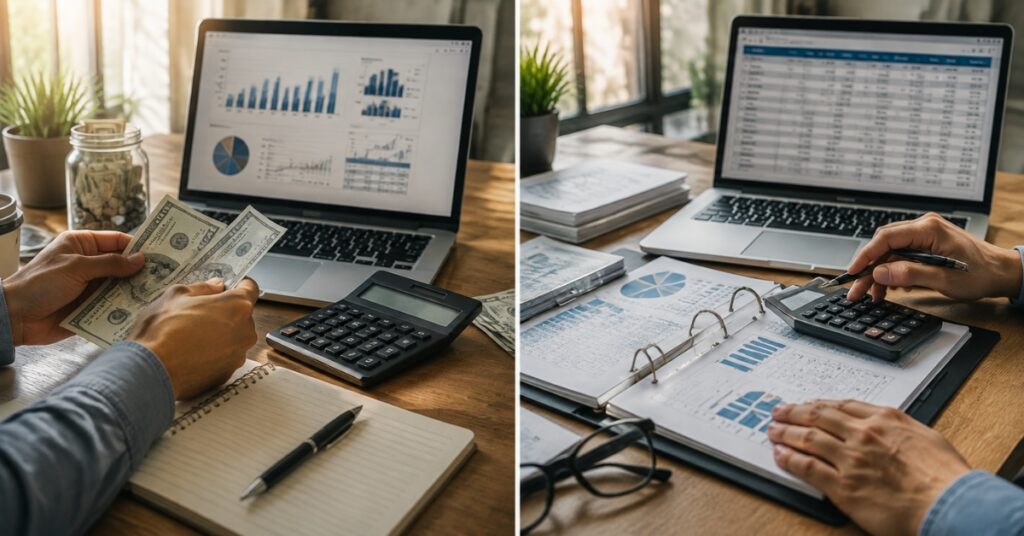
Choosing between cash basis and accrual accounting can affect far more than the way transactions appear in your bookkeeping software. It influences when profits are recognised, how clearly you can see what customers owe, how useful your accounts are for business planning and, for some businesses, when income is brought into the calculation of taxable profit.
For UK sole traders and eligible partnerships, the decision has become particularly important because cash basis is now the standard method for calculating trading profits for Income Tax unless the business chooses traditional accounting. Limited companies, limited liability partnerships and certain other businesses cannot use the Income Tax cash basis and must follow the accounting rules that apply to them.
There is also an important VAT distinction. The VAT Cash Accounting Scheme is separate from the cash basis used to calculate trading profits for Income Tax. A business can therefore have different considerations for its bookkeeping, annual accounts, tax calculation and VAT reporting.
So, which accounting method is better? The answer depends on your legal structure, how customers pay you, the complexity of your business and the financial information you need to make decisions.
What Is Cash Basis Accounting?
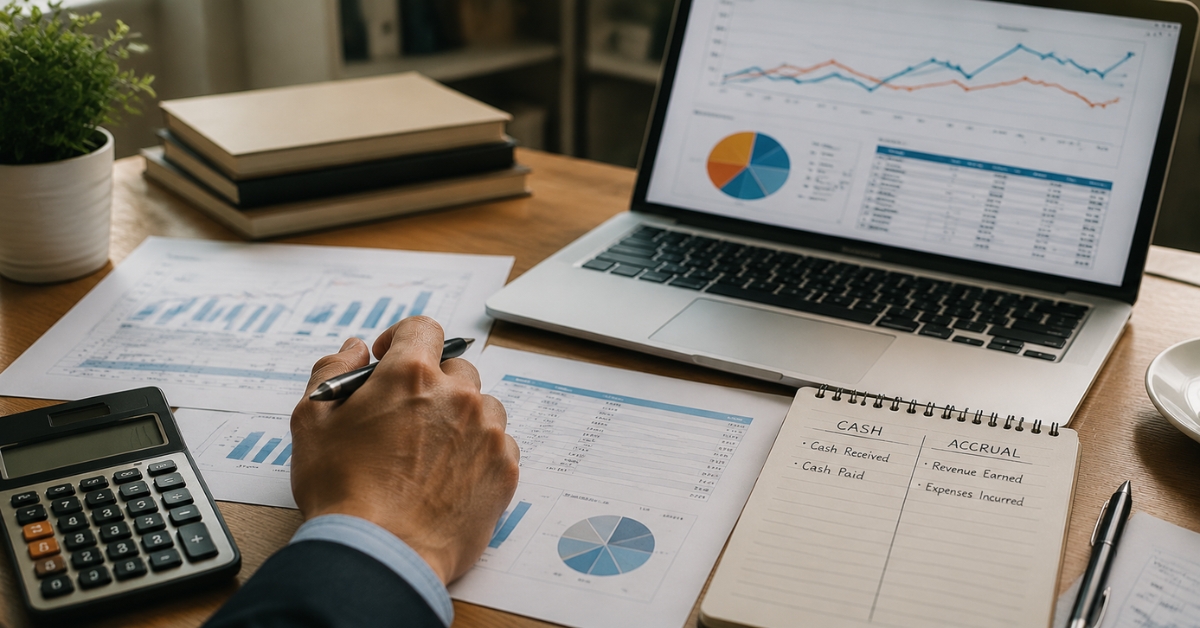
Under cash basis accounting, income is generally recorded when the business actually receives payment, while expenses are recorded when they are actually paid.
Imagine a self-employed consultant sends a £5,000 invoice in March but does not receive the money until May. Under the cash basis, that income is recorded when the payment is received in May rather than when the invoice was issued. Similarly, an allowable supplier bill is generally recognised when it is paid.
This makes cash basis relatively easy to understand because the tax records follow the movement of money more closely.
Why cash basis appeals to smaller businesses
For a straightforward sole trader, cash basis can reduce the amount of year-end accounting work required. The business does not normally need to calculate trade debtors and creditors for the purpose of determining its cash-basis taxable profit.
The method can also prevent an eligible business from paying Income Tax on qualifying trading income before the customer has actually paid it. This can be valuable for businesses where clients regularly take several weeks or months to settle invoices.
However, simplicity does not automatically mean that cash basis provides the best information for managing every business.
What Is Accrual Accounting?
Accrual accounting, referred to as traditional accounting in HMRC’s cash-basis guidance, records transactions according to when income is earned and expenses are incurred rather than simply following the date money enters or leaves the bank account.
Suppose a marketing agency completes a project and invoices a customer for £10,000 shortly before its financial year end. If the customer pays several weeks later, accrual accounting will generally recognise the sale in the period in which it belongs rather than waiting for the payment date.
The same principle applies to expenses. Costs can be matched to the period they relate to through accounting adjustments such as accruals and prepayments. HMRC gives the example of an annual insurance payment being spread across the months to which the cover relates rather than treating the entire amount as an expense in the month it was paid.
Why accrual accounting gives a fuller financial picture
Accrual accounts normally show more than what has happened to the bank balance. They can show:
- Sales Made But Not Yet Collected From Customers;
- Supplier Bills That Still Need To Be Paid;
- Costs Relating To Future Accounting Periods;
- The Financial Position Of The Business At A Particular Date.
This can make accrual accounting more useful when management needs to understand underlying profitability rather than simply current cash movements.
Cash Basis vs Accrual Accounting: The Main Differences
The practical difference between the two methods becomes clearer when you look at the same transaction from both perspectives.
A web development business completes a £12,000 project on 20 March and receives payment on 15 May.
Under cash basis accounting, the income is generally recognised when the £12,000 is received.
Under accrual accounting, the income would normally belong to the accounting period in which the work was completed and the income was earned, subject to the applicable accounting rules.
Neither approach changes the fact that the customer owes £12,000. What changes is when the transaction affects the reported result.
The same timing difference occurs with expenditure. Paying several months of insurance, software or other services in advance may create a different expense pattern under accrual accounting because the cost can be allocated to the period that receives the benefit. Under cash basis, expenditure is generally recognised when it is paid, subject to the specific tax rules applying to the expense.
When Cash Basis May Be Better for Your Business
Cash basis is often most useful where the business model is straightforward and the owner wants to minimise unnecessary accounting complexity.
You run a straightforward sole-trader business
A consultant, tradesperson, designer or other self-employed professional with relatively simple transactions may find cash basis easier to maintain.
Where there is little stock, limited borrowing and no complicated year-end adjustments, the additional information generated by accrual accounting may not justify the extra bookkeeping work.
Customers sometimes take a long time to pay
Cash basis can be particularly attractive where there is a significant delay between sending an invoice and receiving payment.
For eligible businesses, the timing of taxable trading income follows receipt rather than the invoice date. That can reduce the risk of having taxable profits calculated using customer invoices that remain unpaid at the end of the relevant tax year.
You mainly manage the business through cash flow
Some small owner-managed businesses make most short-term decisions by asking practical questions such as:
“How much money came in this month?”
“What have I actually paid?”
“How much cash is available?”
For businesses operating at this level of complexity, cash basis records can be easier for the owner to interpret.
The limitation is that money in the bank and business profit are not the same thing. A large bank balance may include money needed for tax, VAT, suppliers or other upcoming commitments.
When Accrual Accounting May Be the Better Choice
As a business becomes larger or more complex, accrual accounting often becomes more valuable because financial decisions increasingly depend on transactions that have happened but have not yet been paid.
Your business carries significant stock
A growing retailer could purchase a large quantity of stock shortly before year end but sell those products over several months.
Simply looking at money paid to suppliers would not necessarily provide the clearest picture of the commercial performance of that period. Businesses with significant stock are among those HMRC identifies as potentially better suited to traditional accounting.
You need stronger management information
Consider an agency with £100,000 in its bank account.
That sounds healthy until the owner discovers that:
- £35,000 is owed to suppliers;
- £20,000 is reserved for tax and VAT;
- £15,000 relates to work that has not yet been delivered;
- customers owe the business another £60,000.
The bank balance alone cannot explain that financial position.
Accrual-based management accounts can give owners a clearer view of outstanding debts, liabilities and underlying trading performance.
You are seeking finance or investment
Banks, investors and other finance providers may want financial information showing what the business owns, owes and is owed rather than simply its historical cash receipts and payments. HMRC specifically notes that a business seeking finance may choose traditional accounting because a lender could ask for this type of information.
Using accrual accounting from an earlier stage can therefore make financial reporting more useful as the business grows.
Your Business Structure May Decide the Question for You
Not every UK business has a free choice between the two methods.
For trading income, cash basis is the standard method for eligible sole traders and partnerships without corporate partners unless they choose to use traditional accounting.
However, the Income Tax cash basis cannot be used by:
- limited companies;
- limited liability partnerships;
- partnerships containing one or more corporate partners;
- certain other specifically excluded businesses.
Businesses that cannot use cash basis must calculate their taxable profits using the appropriate traditional accounting rules.
Limited companies must also prepare statutory annual accounts that comply with an applicable recognised accounting framework. Those accounts include financial information such as a balance sheet and profit and loss account.
This means a limited-company director should not assume that the Income Tax cash basis available to a sole trader is also available to the company.
Cash Basis Accounting and VAT Are Not the Same Thing
This is one of the most common areas of confusion.
The cash basis used to calculate taxable profits for eligible unincorporated businesses is separate from the VAT Cash Accounting Scheme.
Under normal VAT accounting, VAT on sales may become payable to HMRC based on invoices even where the customer has not yet paid. Under the VAT Cash Accounting Scheme, participating businesses generally account for VAT on sales when customers pay them and reclaim VAT on purchases when suppliers have been paid.
A VAT-registered business can use the VAT Cash Accounting Scheme where it meets the conditions. As of July 2026, the standard eligibility limit is estimated VAT-taxable turnover of no more than £1.35 million for the following 12 months, with a requirement to leave the scheme in specified circumstances, including where turnover exceeds the applicable exit threshold.
The important point is that choosing one accounting approach for your financial records does not automatically determine your VAT scheme.
A business should therefore consider these questions separately:
How should the business calculate and report its profits?
How should it account for VAT?
Getting this distinction wrong can create bookkeeping errors and VAT returns that do not reconcile properly with the underlying accounting records.
How Each Method Can Affect Business Decisions
The best accounting system is not simply the one that produces the easiest tax return. It should also provide the information needed to run the business effectively.
Cash basis emphasises immediate liquidity
Cash basis records make it relatively easy to see completed cash movements.
That can suit an owner who runs a simple service business and has few unpaid invoices or supplier balances.
However, a cash-based profit figure can sometimes be distorted by timing. Paying a major annual expense just before the tax year end, for example, could make one period appear significantly weaker while the next appears stronger, even though the commercial activity of the business has changed very little.
Accrual accounting emphasises economic performance
Accrual accounting attempts to place income and related costs into the periods to which they belong.
For management purposes, this can make comparisons between months, quarters and years more meaningful.
A business planning to open another location, employ more staff or seek external funding may therefore benefit from accrual-based information even where the owner is legally eligible to use cash basis for Income Tax.
The most useful accounting method is ultimately the one that supports both compliance and the quality of business decisions.
Can You Change from Cash Basis to Accrual Accounting?
An eligible business can choose traditional accounting instead of cash basis. However, switching methods is not simply a matter of changing a setting in bookkeeping software.
Adjustments may be required to ensure that income and expenses are not counted twice or omitted during the transition. HMRC specifically notes that businesses moving to traditional accounting may need to make adjustments.
For example, invoices that were not previously included because customers had not yet paid may need careful treatment when moving onto accrual accounting.
Switching is therefore best planned before the end of an accounting period, particularly where the business has substantial outstanding invoices, unpaid supplier bills, stock or other year-end balances.
Making Tax Digital Makes Good Bookkeeping More Important
The distinction between accounting methods remains important, but the wider direction of UK tax administration is towards more frequent digital record keeping.
Making Tax Digital for Income Tax began applying from 6 April 2026 to qualifying sole traders and landlords with total qualifying self-employment and property income above £50,000, with further thresholds scheduled to bring additional taxpayers into the system from April 2027 and April 2028. Those within the rules must use compatible software for digital records and quarterly updates.
Cash basis remains the default accounting method for relevant self-employment and property income within the MTD process, while businesses using traditional accounting can make the necessary accounting adjustments through their software.
For VAT, businesses within Making Tax Digital requirements must also maintain the required digital records and submit VAT returns through compatible software.
The practical lesson is that choosing the right method is only part of the decision. Businesses also need bookkeeping systems that consistently record invoices, payments, expenses and VAT correctly throughout the year.
How to Choose the Right Accounting Method for Your Business
There is no single method that is best for every business.
Cash basis may be the stronger option when your business is eligible, relatively straightforward and primarily concerned with keeping administration simple.
Accrual accounting may be preferable when financial complexity increases and management needs a clearer picture of outstanding income, liabilities, stock and underlying profitability.
Before deciding, consider:
- Business structure: Are you legally eligible to use cash basis?
- Customer payment terms: Do customers regularly take months to pay?
- Business complexity: Do you hold significant stock or have substantial unpaid balances?
- Growth plans: Will you seek finance, investment or more sophisticated financial reporting?
- VAT position: Would the VAT Cash Accounting Scheme separately benefit your cash flow?
- Management needs: Do you need accounts that show what is owed as well as what has already been paid?
The right answer can also change over time. A method that works perfectly for a one-person consultancy may become restrictive once the business takes on employees, stock, finance and larger customer contracts.
Conclusion: Choose the Method That Matches the Business You Are Building
Cash basis accounting offers genuine simplicity. For many UK sole traders and straightforward partnerships, it can reduce accounting complexity and align the calculation of taxable trading profit more closely with actual payments received and made.
Accrual accounting provides a different advantage: visibility. By recognising income and costs in the periods to which they relate, it can give business owners, lenders and decision-makers a more complete view of financial performance and obligations.
The key is not to treat the choice as a simple battle between “easy” and “complicated”. The better question is whether your accounting method gives you the information you need while meeting the rules that apply to your business.
As digital reporting becomes more deeply embedded in the UK tax system, accurate and well-structured bookkeeping will become increasingly important regardless of the accounting basis used. Choosing the right method early and reviewing that choice as the business grows can make tax compliance easier while giving you better information for future decisions.
For businesses dealing with VAT, the decision should also include a separate review of the available VAT accounting schemes. Interface Accountants provides VAT support for limited companies, sole traders, partnerships, contractors and other UK businesses, including advice on selecting an appropriate VAT scheme and maintaining compliant records.
Frequently Asked Questions
Is cash basis accounting now compulsory for UK sole traders?
Cash basis is the default method for eligible sole traders, but they can choose traditional accounting instead.
Can a limited company use cash basis accounting for Corporation Tax?
No. Limited companies cannot use the Income Tax cash basis available to eligible unincorporated businesses.
Is cash basis accounting the same as VAT cash accounting?
No. The Income Tax cash basis and the VAT Cash Accounting Scheme are separate systems with different rules and eligibility requirements.
Which method is better for a growing business?
Accrual accounting is often more useful where a business has significant stock, unpaid invoices, supplier liabilities or plans to seek external finance.
Can I switch from cash basis to accrual accounting?
Yes, where the rules allow, but transitional adjustments may be required to ensure transactions are reported correctly when the accounting method changes.