


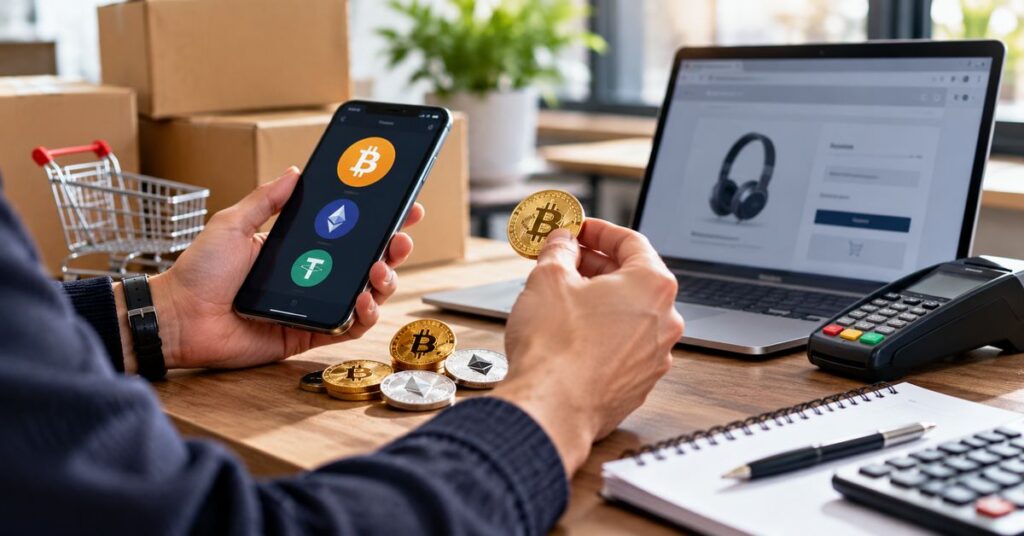
Paying for a laptop, furniture or everyday shopping with cryptocurrency can create a capital gain or loss. For a UK resident holding crypto personally, HMRC treats spending tokens as a disposal, even when no pounds enter your bank account. Whether tax is payable depends on the gain and your wider position for that tax year.
The practical task is to establish the sterling value of each payment, deduct the correct allowable cost and check your reporting obligations. The amount you spend is not automatically the amount you owe tax on.
Why a purchase can create a capital gain
When you pay a retailer with crypto, you give up tokens in exchange for goods. Their value may have increased since you acquired them, so the purchase can realise that increase.
For example, spending tokens worth £900 does not necessarily create a £900 taxable gain. If their allowable acquisition cost was £600, the starting gain is £300 before any further allowable expenses.
You therefore need more than the shop receipt. You also need the acquisition history of the tokens used. Interface Accountants’ cryptocurrency taxation service provides advice on the tax treatment of crypto holdings and disposals.
Calculate the payment in pounds
Your calculation must use sterling, including where a retailer quotes a price in tokens or another currency. Record the transaction value when the purchase takes place; do not use the token’s price when you prepare your return months later.
Keep the invoice and payment confirmation together. Where there is no reliable sterling figure, use an appropriate exchange rate and retain evidence of your valuation method. HMRC expects reasonable care and a consistent approach.
A straightforward illustration looks like this:
| Calculation | Amount |
| Sterling value of goods received | £1,200 |
| Allowable cost of tokens spent | £750 |
| Allowable disposal fee, paid separately in pounds | £10 |
| Capital gain | £440 |
This assumes the £750 cost has already been established under the correct matching rules. Qualifying transaction costs can reduce the gain, but not every account charge is deductible. Never deduct the same expense twice.
Use the correct acquisition cost
If you acquired the same cryptocurrency several times, you cannot simply choose the most expensive purchase to reduce your gain.
For interchangeable tokens held personally in the same capacity, the matching order is generally:
- Tokens of the same type acquired on the day of the disposal.
- Tokens of that type acquired within the following 30 days.
- The relevant share of the remaining pooled allowable cost.
Each token type has its own pool. Holdings across different wallets or exchanges normally belong in the same pool where the beneficial owner and ownership capacity are the same.
This matters if you regularly replace crypto after spending it. A purchase made after your shopping transaction can change the allowable cost assigned to that disposal. Buying replacement tokens in April may even affect a payment made before the tax year ended on 5 April.
Check whether tax or reporting is required
For 2026/27, the annual Capital Gains Tax allowance for most individuals is £3,000. This covers your overall taxable gains, including relevant gains from other assets; it is not a separate allowance for each cryptocurrency or purchase. Allowable losses can also affect the calculation.
Current individual CGT rates are generally 18% and 24%. Your taxable income and gains determine how much falls within each rate. Being a basic rate Income Tax payer does not necessarily mean your entire gain is taxed at 18%.
Reporting and paying tax are separate questions. If you are registered for Self Assessment, you must also report gains where total disposal proceeds exceed £50,000, even when gains fall below the allowance. Consider relevant disposals across the year, including crypto spending, rather than only cash withdrawals.
Include the figures in the correct tax year
The UK tax year runs from 6 April to 5 April. A purchase made on 16 October 2026 therefore falls within 2026/27.
When reporting through Self Assessment, enter the relevant figures in sterling in the cryptoasset section of the Capital Gains Tax pages. Keep supporting calculations showing how you arrived at the totals. A payment history alone is not a completed tax calculation.
Under the standard timetable, someone who needs to register for Self Assessment for 2026/27 should notify HMRC by 5 October 2027. The normal online filing and payment deadline is 31 January 2028.
Interface Accountants’ tax return services can help bring crypto calculations together with the other information required for your return.
Keep records that explain each payment
For every purchase, retain:
- The date, token type and quantity spent.
- The retailer’s receipt and sterling transaction value.
- Wallet transaction references and payment confirmations.
- Acquisition records and relevant fees.
- Matching calculations and updated pool balances.
Export transaction histories regularly. A bank statement may show the original purchase of crypto but cannot explain everything that happened afterwards. Likewise, a retailer’s invoice will not show your pooled acquisition cost.
Reconcile transfers between your own wallets so they are not mistakenly counted as purchases or sales. Retaining beneficial ownership normally means the transfer itself is not a disposal.
Five frequently asked questions
1. Does buying something inexpensive avoid crypto tax?
There is no general exemption simply because the purchase is small. You still need to calculate the disposal result. Whether tax becomes payable depends on your overall annual gains, losses and available allowance.
2. What happens if I pay through a crypto debit card?
Check when the provider converts your crypto. If tokens are sold automatically at checkout, that conversion is the disposal. If you converted them into pounds earlier, the earlier conversion is normally the relevant event. Spending the resulting sterling balance does not create another crypto disposal.
3. Can spending crypto create a claimable loss?
Yes. Where the allowable cost exceeds the disposal value, an allowable capital loss may arise. This can reduce capital gains, subject to the rules. Losses generally need to be claimed within four years after the end of the disposal tax year.
4. What if I already paid Income Tax when receiving the tokens?
That does not remove the need to calculate the later disposal. However, the value already subject to Income Tax is taken into account so it is not taxed again as a capital gain. Further growth before spending may still produce a gain.
5. Are stablecoin payments automatically tax free?
No. Spending a stablecoin is still a disposal. A token linked to a foreign currency can change in sterling value because exchange rates move. Calculate the sterling result rather than assuming a stable quoted price means there is no gain.
Make tax records part of the purchase
The key question is how much gain or loss arises from the tokens you spend, followed by whether your annual figures require reporting or payment. Accurate sterling values, correct matching and complete records make those decisions easier.
If you plan to use crypto for more purchases, review your records throughout the year and reserve pounds for any likely tax bill. Spending the tokens does not leave cash behind to pay HMRC. Before making a substantial purchase, understanding the potential gain gives you a clearer picture of its full cost.